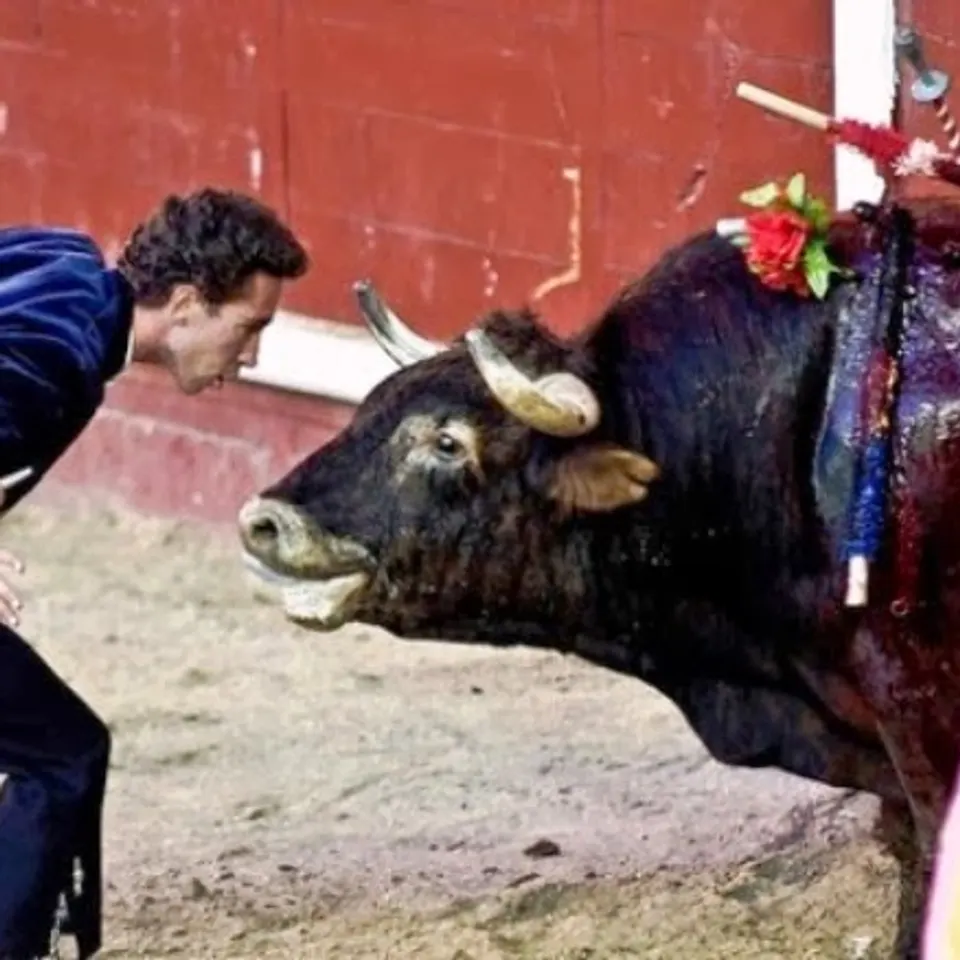
Bullfighting, corridas de toros or lidia, is a spectacle in which, appealing to "art" and "bravery," a bull is tortured and "artistically" killed in a ring for the amusement of those who pay to watch. Other animals harmed by bullfighting are horses. Bullfighting was invented on the Iberian Peninsula in the 12th century under the power of Catholicism, and from its origins it was already condemned by part of society: Alfonso X the Wise, the Catholic Church, Pius V, Philip V, Ferdinand VI, Charles III, Charles IV, Vargas Ponce, the Marquis of San Carlos... Pope Pius V said: "Those spectacles in which bulls are run have nothing to do with Christian piety; being bloody and shameful spectacles, fit not for men, but for the Devil." Bullfighting is still legal today in Spain (except in the Canary Islands and Catalonia), in Portugal, in the south of France, in Mexico, Colombia, Peru, Venezuela, Ecuador and Costa Rica. It is also a showcase spectacle in China, the Philippines and the United States. Fans of bullfighting and of other spectacles in which bulls, cows and horses are also mistreated are called taurinos.
Manipulation of language
Anti-bullfighting people are not against bulls, but against bullfights, or bullfighting. Anti-bullfighting people defend bulls, and bullfighting fans defend bullfighting. There is nothing more hypocritical and manipulative than a bullfighting fan saying "long live the bulls!" or using the silhouette of a bull as a symbol, since it is a symbol they violate and destroy in a spectacle. If bulls symbolize anything, it is life, strength and nobility, whereas the bullfighter is a symbol of torture, death, weakness, betrayal and ethical backwardness.
Bullfighting fans claim they "love the bull," yet they defend sticking it with lances, banderillas and swords. It is similar to the language used by those who abuse women, who say "I hit her and I kill her because I love her."
Mistreatment on fighting-bull ranches
There are a number of abuses to which the bulls living on the breeding ranches are subjected
- Sheathing
- Shaving
- Dehorning
- Transport conditions
- Closed-door fights in which bullfighters, novice fighters, mounted bullfighters, bullfighting apprentices and banderilleros train and kill animals of various ages, usually calves (under 2 years) and young bulls (animals of 2 and 3 years). Sometimes this kind of training is also carried out with cows.
- Lañado
- Branding that causes burns with a red-hot iron
- Tentaderos (testing sessions) of females and males in the ranch's ring and in the field
- Practices uncovered on the ranch of a Portuguese mounted bullfighter: "training of alano dogs with fighting cows."
Transport to the ring
Bulls suffer a great deal of stress during transport, losing dozens of kilos because of it.
Silenced suffering
On August 22, 2016, José Sepúlveda S., a television sound technician who often had to work on bullfighting broadcasts, shared on Facebook what he witnessed many times from his workstation:
"In my case, having had to handle the sound on some broadcasts, I have always said that if instead of the sound mix of the band, applause, bravos, olessss and so on... the sound were what the Sennheiser 816 (a microphone that picks up at long distance and with good quality) captures at ringside, where you can perfectly hear the sound of the banderillas going into the skin, the bellows of pain the animal gives at each torture it is put through... and if we also accompanied it with close-ups of the wounds it carries, of the clots the size of the palm of a hand, of the blood that gushes out in time with the beating of the heart, or of the look the animal has before the final sword thrust, I believe 90% would turn off the television on witnessing such a butchery set to a pasodoble.
I personally asked to stop doing that kind of work, precisely on a day in Castellón when I had to be in the callejón (the passage around the ring) and I got very angry listening to a bull, which the bullfighter missed four times with the sword, and sick of listening to the poor animal I took off my headphones... That was not enough for me: while it was dying, spitting, drowning in its own blood, it came to die right up against me, leaning on the wooden boards while it gasped, and its bloodied and tearful gaze, yes tears, whether or not they were from pain, met mine, and we did not lose each other until a useless .... missed twice with the descabello, and I told him everything I thought of him. That was the end of my bullfighting career for life.
These are personal feelings and most likely a lover of "the fiesta" will find them ridiculous, but to me, what is more ridiculous is that after such a butchery, you turn your eyes to the audience and see them there applauding, eating their sandwich without flinching, without having seen and heard what I did."
Picadors in the "suerte de varas" The picador is, in bullfights, the one in charge of preparing the bull for the muleta stage. He bears the responsibility for the mounted part of bullfights where the bullfighters are on foot. He uses a long pole with a metal tip to stab the bull and tear the tissues located in its withers, not only to weaken the animal, but also to reduce its ability to charge by making it lift its head. Some opinions consider them an evolution of the old spear bullfighting that European nobility were fond of until the high Middle Ages. Until well into the 20th century, specifically until 1928, in the middle of the Primo de Rivera dictatorship, the picadors' horses were old or ailing horses that had no protection and were condemned to die in the ring. Today it is not unusual for some horses to die from time to time from the heavy impacts they suffer and sometimes from goring.
Bullfighting proper
Bovines only exercise 3% of their lifetime. During the faena with the muleta, the bull is forced to perform very intense physical exercise, which causes significant organic disturbances.
Punishment banderillas
In the past, banderillas with explosives were stuck into bulls. They were replaced by black banderillas, which are stuck deeper into the bulls' bodies than normal banderillas.
The sword thrust
The estoque is a steel sword with a length of 80 cm to 88 cm, from the hilt to its tip. The third stage of the fight, or "supreme act," begins with the sword thrust into the bull. The bull is run through with the sword, which will destroy internal organs (liver, lungs, heart, pleura, arteries, etc.), depending on where the sword enters its body. If the bull "is lucky" (14% of cases), the sword will sever large vessels of the chest cavity, such as the caudal vena cava, and it will die quickly. Otherwise it will go through extreme pain and suffering, sometimes dying drowned in its own blood.
The descabello
If after the sword thrust the bull does not go down on its forelegs, that is, if it remains standing in the ring longer than normal, the descabello is carried out. In the descabello the bullfighter drives into the bull's nape a sword called the "descabello sword" or "verduguillo," which has a fixed cross-shaped stop 10 cm from its tip, with the aim of severing the spinal cord at the level of the first and second cervical vertebrae or at the occipito-atlantoid opening. In this way the bull is left quadriplegic (they call it "descordar"), falling to the ground if it was standing, or being unable to rise if it was already down. The descabello is not easy, so the bullfighter usually stabs it several times, with the resulting pain and suffering. In these cases the bullfighter jabs the bull's muzzle with the verduguillo to make it lower its head more, increasing its pain and suffering. Once the bullfighter manages to leave the bull quadriplegic, it will still be conscious, and will be finished off with the puntilla.
The puntilla
The puntilla consists of killing the bull by savagely driving a 10 cm knife into its nape. In 2006, the World Organisation for Animal Health banned, because of its cruelty, the use of the puntilla to kill bovines in slaughterhouses, but it is still used in bullfights. José Enrique Zaldívar Laguía, veterinarian and representative of AVATMA, explains it as follows in his article "Request to the Real Academia Española to change the term 'descabellar'":
"With the use of the puntilla, the respiratory muscles, including the diaphragm, are paralyzed, so the animal suffocates. It can take between 1 and 4 minutes to lose consciousness depending on its age, its physical condition and its genetic inheritance. In addition, as a consequence of the severing of the arteries, the blood will reach the brain loaded with CO2, causing cerebral hypoxia."
When a bull kills a bullfighter
When a bull kills a bullfighter, they do not cut off the bullfighter's two ears and tail, nor is the bull taken out through the main gate; instead, the bull is killed. Moreover, it is a bullfighting tradition that the mother of the bull that killed the bullfighter is sent to the slaughterhouse to end its line. The article "Víctor Barrio, a broken hope" mentions this bullfighting tradition: "The line of Lorenzo, the killer bull, ends with him. As tradition dictates, the breeder of Los Maños, of Santa Coloma stock, will send his mother, the cow Lorenza, to the slaughterhouse." It is curious that when the bullfighter kills a bull, neither the bullfighter nor his mother is killed.
Pro-bullfighting arguments
The following arguments are used to try to justify bullfighting:
- "The fighting bull exists to serve us, it was born for that
- "The bull does not suffer"
- "Bullfights are culture"
- "Bullfights are an art"
- "Bullfighting is a source of wealth"
- "Bullfights are a tradition and therefore must be respected"
- "Animals kill each other, there is nothing wrong with us doing it too"
- "Without bullfights the bull would go extinct"
- "Without bullfights the dehesas would disappear." Some bullfighting fans say that if bullfighting were banned, the dehesas (the wooded pasturelands) where these animals live would disappear. According to the report "Toros y Dehesas," the dehesa area occupied by the fighting bull in Spain is only 7.5%, so the dehesa can hardly be threatened by the disappearance of bullfighting. Moreover, there are humane alternatives for keeping the bull in the dehesa beyond bullfighting, such as tourism or a national park.
Other bullfighting spectacles
There are also other bullfighting forms in which bulls and cows are mistreated.
Heifer bullfighting, release of cattle or capeas
In bullfighting, heifer bullfighting, release of cattle or capeas are understood to be festivities consisting of running or fighting fighting cattle aged 2 to 3 years, or even younger or older, by amateur participants in a ring or enclosed space, or through the streets of a town.
Recortes
There are people who oppose bullfights but claim that in the spectacle known as recortes, bulls are not harmed.
The bulls used in recortes have been forced out of their habitat and separated from their herd. They have then been forced into a cage at the back of a vehicle. Then they have been transported hundreds of kilometers, with all the stress that means for someone in that situation who does not understand what is happening. Then the bull is forced into pens, sometimes cramped. After that it is forced out into a circular ring with no exit. The stands are full of humans shouting and making all sorts of noises. In the ring there are humans who bother the bull to do their acrobatics and entertain the crowd for a while. After that the bull goes back to the pen, and who knows whether the next day they will do the same to it again or whether it will be moved somewhere else.
Becerradas
A becerrada is a bullfight in which the victims are calves under two years of age, who are tortured psychologically and physically with sharp objects (banderillas) and killed with a sword or knives by members of a town's peñas (social clubs) or by other people. The Association of Veterinarians Against Bullfighting and Animal Abuse (AVATMA) produced a "Veterinary Technical Report on Becerradas" detailing the suffering to which calves are subjected in these spectacles. In the article "How to regulate the cruelest animal abuse," the veterinarian José Enrique Zaldívar Laguía asks how it is possible that from a legal point of view becerradas are still allowed to exist. Becerradas are usually held behind closed doors to the press, which is why activists have to make their recordings discreetly.
Correbous
"The correbou is a bunch of brave men who harass the animal, after setting two balls of fire on its horns (the toro embolat), or tying it by the horns to a wall or tree (the toro capllaçat). And that's it, the event is organized. Everyone laughs and has a great time with the bellowing and panicked bolting of the bull, which, of course, has nothing to do with the fighting bull of the bullfights."
Fire bull or embolado bull
On July 28, 2016, the Association of Veterinarians Against Bullfighting and Animal Abuse (AVATMA) produced a report titled "Veterinary technical report on the suffering of 'fire bulls' or 'embolado bulls'," which details meticulously the suffering to which bulls are subjected in this kind of spectacle. It even classifies this spectacle as one of the cruelest: "The intense physical and emotional suffering endured by the bulls during the spectacles described in this report leads us to classify them as some of the cruelest examples of institutionalized animal torture in our country, ethically unacceptable from any point of view."
The Toro de la Vega
Every year in September a spectacle called "El Toro de la Vega" takes place in the town of Tordesillas, in which lances are thrust into a bull until it dies. On November 29, 2015, the Association of Veterinarians Against Bullfighting and Animal Abuse (AVATMA) published "The Toro de la Vega does suffer," a letter to José Antonio González Poncela, mayor of Tordesillas, in response to statements in which he claimed that "The bull feels pain but does not suffer." The letter sets out, from a veterinary point of view, the suffering bulls endure when they are used in this spectacle.
The mistreatment in the encierros
Nobody likes being made fun of, and that is precisely what happens in the encierros (bull runs). Encierros are a bullfighting spectacle held mainly in towns, although they are also held in some cities, most notably Pamplona (San Fermín) and a few others. The bulls are transported from the ranch to pens located at the place where the encierro will take place. The bulls are taken out of the pen and driven to run along a fenced route to the bullring, where they will later be mistreated to death. Bulls and cows suffer fear, stress and exhaustion in the encierros. It is common for the bulls and cows used in encierros to suffer injuries from falls, and sometimes some of them die from a broken neck, from the goring of another nervous bull, or from a heart attack. Other times they are killed by a shot from the police or even from a fan. The laws require that the bull be killed after the encierro, except in Navarre, Aragon, the Valencian Community and Catalonia.
Bullfighting fans who regretted the abuse
Some bullfighting fans realize the abuse they cause or promote and decide to become anti-bullfighting, animal rights advocates and even vegans. One example is the former Colombian bullfighter Álvaro Munera.