
Gary Francione is the leading living exponent of Animal Rights. He set out the six sections that make up the so-called “Abolitionist Approach.” The Abolitionist Approach consists of the ethical reasons why we must uphold and defend Animal Rights in order to achieve the abolition of animal exploitation.
Animal Rights have an ethical and a legal side. In practical terms, they rest on recognizing that other animals deserve the same respect recognized for humans. Thus, honoring Animal Rights by following the six points of the abolitionist approach is a moral duty, both to act justly toward the victims and to be consistent with our other ethical principles.
The term abolitionism is often twisted, misunderstood or corrupted through ignorance or personal or institutional interests. Abolitionism, in Animal Rights, is defined as the action and effect of abolishing animal exploitation as the result of assuming rights. So it is only considered abolition when one or more forms of animal exploitation are abolished through a recognition of rights. Banning a practice without first achieving rights is an act and maneuver typical of welfarism. There are hundreds of organizations that profit through lies by promising a protection that is legally impossible.
Today, no animal species other than our own has recognized rights, and there can be none as long as they remain classified as “movable goods that move on their own” (objects with autonomous movement). It is worth noting that what matters does not lie in the name but in the legal link. In other words, it matters little whether they are considered sentient beings, because their interests will still be subordinated to those of humans. Likewise, in ethics the concept of species (biology) has no validity, because what marks the possession of rights (inherent value) is the possession of inalienable interests. Those who have interests are the subjects themselves, not the more or less similar abstract groups formed by such individuals. Our society discriminates morally according to species, and this is called speciesism. The same applies to the concept of “race” and to racism.
The abolitionist approach rejects the utilitarian view of Singer, author of the famous work “Animal Liberation” (which, paradoxically, opposes animal liberation), and offers a deontological reasoning similar to that of human rights philosophy. It resembles Tom Regan's theory in some respects, but its greatest difference is that it starts from the concept of property (possessions) as a reflection of the anthropocentric mindset that must disappear through educational and nonviolent activism in order to establish a new social paradigm.
The abolitionist approach rejects the use of all nonhuman animals as resources (exploitation) for the satisfaction of any human ends. The doctrinal basis for this rejection rests on the fact that all humans have the fundamental, pre-legal right not to be treated as resources for others. This is the right that governs the exclusion of slavery of human beings. Having intrinsic value means the subject deserves respect because it values its own existence, even if no one else does or ever would.
This foundation would remain valid in the case of other animals because they also value their own existence, as we can observe empirically. If animals matter morally, we cannot treat them as if they were resources, and we are obliged to recognize their right not to be property in order to exclude them from our exploitation.
Even assuming the position of moral relativism, we observe that every human society recognizes the injustice of causing unnecessary harm or suffering to other individuals. This proto-moral consideration, called the “humane principle,” shows that ethics rests on an inherent logic derived from cognition.
Second principle: refutation of single-issue campaigns
“Animal welfare” reforms do not work because of the status of nonhuman animals as property. It costs money to protect the interests of such animals, and we only protect their interests when it brings us a benefit, which is almost always economic. The property status of other animals limits the benefits of reform. Most reforms do nothing more than modify practices so that, for example, by increasing conditioning costs, veterinary costs go down, which improves production efficiency for institutional exploiters. Even in situations where production costs rise, this increase rarely exceeds the elasticity of demand in the market, and the market for animal products is not negatively affected. Welfarist reform, therefore, does nothing to eradicate the property status of animals. Moreover, animal welfare measures make the public feel comfortable taking part in animal exploitation (it relieves the consumer's guilt), and this motivates continued use of nonhuman animals.
The abolitionist approach to Animal Rights, besides rejecting reformist animal welfare campaigns, disapproves of single-issue campaigns that seek to ban certain uses of animals rather than reform the standards of exploitation themselves.
Third principle: embracing veganism
Veganism must be the minimum moral baseline that guides human behavior if we are to be just to other animals. Veganism is the only rational response to the idea that animals have moral value.
The problem is not that there are people dedicated to breeding, crowding and killing nonhuman animals, but the consumption by the human population. That consumption validates animal exploitation and prevents a recognition of rights.
The solution begins with reducing demand. To do so, we must promote veganism as the ethical foundation that allows moral agents (humans with full capacities) to understand the immorality of animal exploitation.
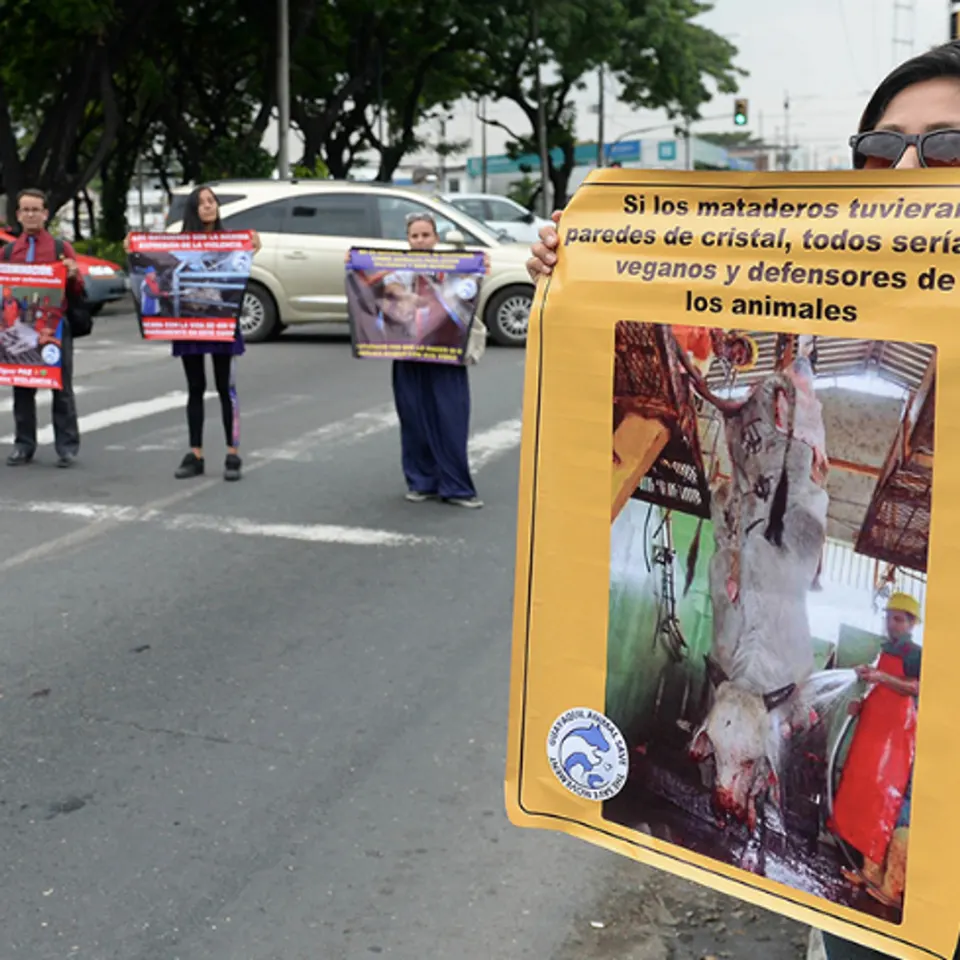
To achieve abolition, activists must focus on creative, nonviolent vegan activism.
Fourth principle: rejection of gradualism
Welfarism and other perceptions derived from moral anthropocentrism lead the human population to consider that some animals are worth more than others according to their genetic closeness to humans (e.g. primates), for reasons of contextual closeness (e.g. dogs, cats, etc.) or because of a high level of intellect (e.g. cetaceans).
Animal Rights, by taking veganism as the foundation of our relationship with other sentient beings, holds that the mere presence of the capacity to feel is a sufficient requirement for having rights, because sentience in itself entails the possession of interests, desires and a consciousness, minimal at least, by which the organism knows how to distinguish itself from its environment.
Therefore, every living being capable of perceiving sensations must have rights. The abolitionist approach focuses on animal exploitation because we animals are the only known group capable of feeling.
Fifth principle: ethical coherence
Animal Rights oppose speciesism because, like other forms of moral discrimination, it relies on an irrelevant criterion (species) to disregard and discriminate against the interests of other sentient beings. Opposition to speciesism only makes sense as part of a general position against all unjust forms of discrimination.
Therefore, our opposition to speciesism requires us to oppose all moral discrimination regardless of who the victim is.
Sixth principle: rejection of violence
Violence is a subtype of exploitation in which one individual uses another as a resource to vent their aggression (a biological condition). Since systematic violence against other animals is a consequence of their moral objectification, using violence against humans or property is also the result of contempt for their moral value. For this reason, the abolitionist approach condemns violence as a means of achieving justice for other animals. Rescuing nonhuman animals is legitimate as long as it does not involve violating the interests of third parties, in compliance with the principle of equality.
text: http://elguardiandeloscristales.com