Milk is a secretion produced by the mammary glands of female mammals. The main function of milk is to nourish their young until they are able to digest other foods.
Humans began exploiting nonhuman animals to steal their milk about 11,000 years ago, especially in the Middle East, and the first victims were cows and goats. Later, between 9000 and 8000 BC, sheep were exploited for their milk, and animals of other species were gradually exploited as well. Today the animal most exploited for its milk is the cow, but goats, sheep, buffalo, camels, mares, moose, pigs, llamas, etc. are also exploited for milk.
Milk contains microorganisms that are harmful to humans, which is why it is treated with several procedures before being sold: pasteurization, UHT, sterilization, etc.
Mammals produce milk because they have given birth
Some people believe there are cows that always produce milk, but this is not true. The mammary glands of cows, just like those of women, only produce milk after giving birth.
"For a female mammal to give milk, she must have been fertilized, completed gestation and, therefore, given birth. The difference between species is that some of them have great difficulty coming into heat again and becoming pregnant while lactation lasts. Others, like the cow, can come into heat a few weeks after giving birth and, if she becomes pregnant, the lactation resulting from the previous birth overlaps with the gestation of a new calf." Antonio Callejo Ramos, senior lecturer at the Dept. of Animal Production, E.U.I.T. Agrícola (Universidad Politécnica de Madrid).
A few days before giving birth, the cow's mammary gland begins to produce milk to feed the calf she is about to deliver. The mammary gland reaches its peak milk production two months after birth, after which production begins to decline. To keep milk production from dropping, the cow is raped again so that she gives birth again, and the birth boosts her milk production once more. Before giving birth, the cow goes through a "dry period," a few days in which the mammary gland is left to rest.
Confinement and milking
At least half of the 10 million cows raised to be milked in the United States live on factory farms in conditions that cause them enormous suffering. Dairy cows destined for industrial milk production are confined inside milking pens or barns with concrete floors, where machines milk them two or even three times a day, so that they produce four and a half times more milk than they would to feed their calves. Milking machines often cause them cuts and wounds that would not happen if milking were done by hand. These wounds encourage the development of mastitis, a painful bacterial infection. More than 20 different kinds of bacteria cause the infection, which spreads easily from one cow to another and, if not controlled, can cause death. In some cases, milking machines also give electric shocks as a result of voltage leaks, causing the cows great distress, fear, damage to the immune system and, in some cases, death. According to the article "Stray Voltage Killing U.S. Dairy Cows," by Jack Anderson and Dale Van Atta, published on August 9, 1989 in The Washington Post, a single farm may lose several hundred cows a year because of voltage leaks.
Many producers use a variety of drugs, such as bovine growth hormone (BGH), antibiotics and even tranquilizers, to influence the productivity and behavior of the cows.
Vaginal and anal rape of cows
Artificial insemination has been used on cows since the 1940s. Prostaglandin has usually been used to bring the cow into heat when the producer wants her to be inseminated. The most common artificial insemination in cattle is recto-vaginal, which consists of putting one hand into the rectum to hold the cervix while a pipette of sperm is inserted through the vagina.
The sperm is stored in different containers such as ampoules, pellets or straws and is frozen before use. Artificial insemination allows exploiters to obtain a much larger number of offspring from one bull than through natural reproduction. The donors used for insemination are selected bulls with qualities that are particularly interesting to the exploiter, and artificial insemination lets him make better use of the male, achieve genetic improvements, increase fertility or avoid passing venereal diseases on to the cow. One of the consequences of artificial insemination is anal prolapse.
Separation of mother and child
Calves are of no benefit to the dairy industry because they drink the milk, so they are separated from their mother and destined for replacement (to replace the cows who have been killed) or for fattening. Calves classified for fattening are sent to intensive fattening farms for veal production. As mammals, cows have a very strong maternal instinct, and so they suffer enormously when they are separated from their young, and their cries can be heard for days. There have been cases of cows who did astonishing things to be with their calves again. One of them walked 7 miles to reunite with her son after he was sold at auction. Separating a calf from its mother causes it suffering that is hard to imagine.
For the production of any type of milk, including organic milk, the young are separated from their mothers and usually end up at the slaughterhouse.
Slaughter of calves
The calves born to cows exploited for their milk are killed at 6 months of age in slaughterhouses, and their corpses are called "veal." Other calves, those exploited to produce meat called "vitela" or "baby beef," meet an even worse fate. The veal industry is a branch of the dairy industry, as Peter Singer explains:
"As we have seen, the veal industry is a branch of the dairy industry. Producers must make sure that dairy cows get pregnant every year so that they keep producing milk. The young are separated from their mothers at birth, an experience that is as painful for the mother as it is terrifying for the calf. The mother often eases her distress by calling and lowing constantly for days after the calf has been taken away. Some female calves will be raised on milk substitutes to eventually join the ranks of dairy cows, once they reach about two years of age and can produce milk. Other calves will be sold at one or two weeks old and raised for "steaks" in feedlots. The rest are sold to veal producers, who count on the dairy industry so that the diet they feed these young keeps them anemic." Peter Singer, Animal Liberation
Dehorning of calves who will be future "dairy" cows
Dehorning is the process of removing the horns, or the horn-producing tissue, from the skulls of cows using red-hot irons, caustic chemicals, blades or hand saws. Most cows exploited for their milk are dehorned. The U.S. Department of Agriculture reported in 2010 that "more than nine out of ten dairy farms practice dehorning." Workers dehorn cows so that they do not hurt each other or humans as a result of the emotional distress and frustrating conditions they are forced to endure on factory farms, which include being crowded into living areas with thousands of other animals, forced to live among their own waste, forcibly inseminated, and transported to the slaughterhouse once their milk production declines.
The animals often struggle violently and have to be restrained during this painful procedure, which is frequently done without anesthesia or painkillers and causes intense pain that lasts for hours and can even become chronic.
One way of dehorning (sometimes called "debudding") involves burning or tearing out the horn tissue from the skulls of young calves before their horns develop. This procedure is extremely painful and traumatic for young calves, who are often only a few weeks old. Farmers destroy the horn buds of calves with a red-hot iron, which is pressed firmly onto the part of the animal's skull where its horns would grow, producing a cloud of smoke as the flesh is burned.
Another method of dehorning is used on cows that have already grown horns. Farmers amputate the horns, which are attached to the cow's skull through nerves and blood vessels, using saws, sharpened wires or dehorning "guillotines." The wounds caused by this painful amputation can take up to three months or more to heal.
Udder flaming in cows
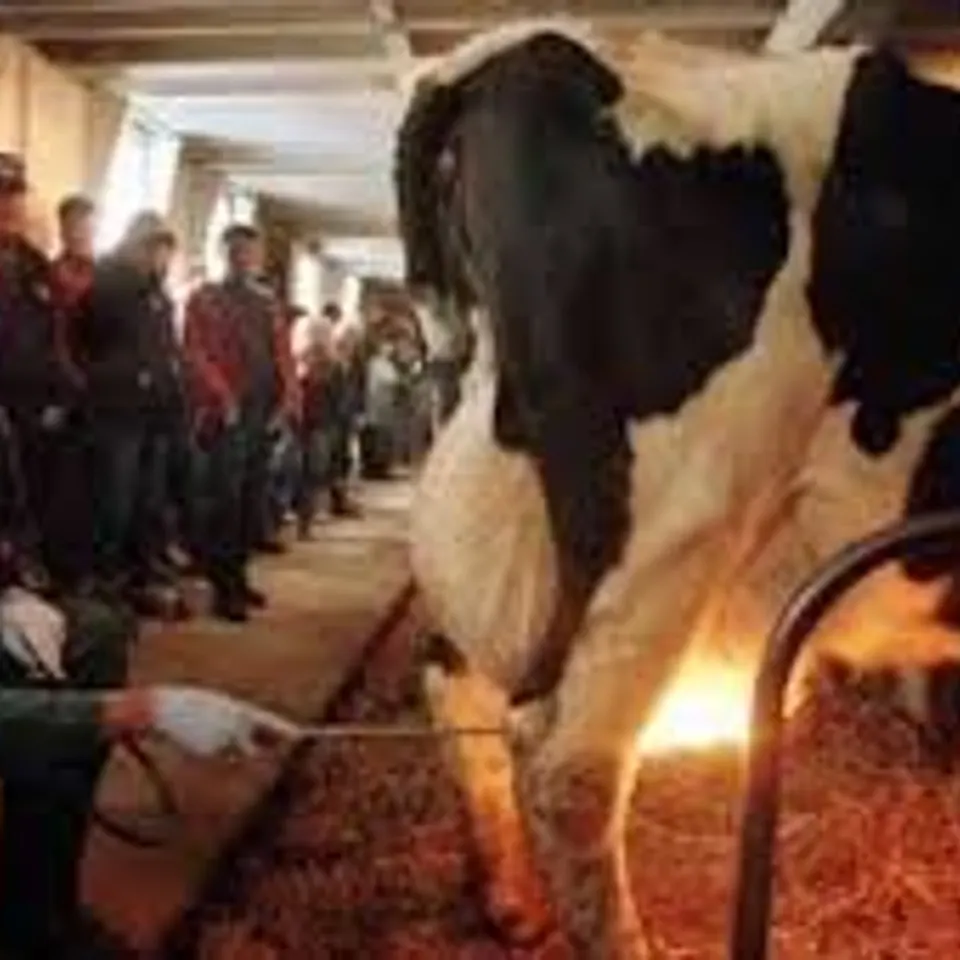
Milk producers claim that removing the hair from cows' udders is a vital process for improving udder cleanliness, reducing the number of bacteria on it. To avoid removing udder hair by hand, farmers practice udder flaming, that is, they burn the hairs off the udders with fire.
Cows' udders are burned to "remove the dirt that gets caught in the hairs of the cow's udder, often because of mud or manure itself. Even after cleaning the udder before milking, residue always remains in the hairs, so thanks to this simple technique, that difficulty is corrected," says Felipe Figueredo to the newspaper Color ABC.
Slaughter of cows and fetuses
Cows have a life expectancy of 20 to 40 years. A farmer or a company has no interest in keeping a cow that does not produce enough milk. When cows are exploited to produce milk, they are sent to the slaughterhouse when they begin to have health problems (infertility, mastitis, etc.) or when milk production drops ("dry cows"). This usually happens when they are 4 to 6 years old. The interests of any exploited animal are always disregarded in favor of the interests of whoever exploits them, so we cannot seriously speak of animals being respected until the day they are no longer bred so that we humans can obtain a benefit from them.
Sometimes cows arrive at the slaughterhouse pregnant. An article published by the British Cattle Veterinary Association reveals that 150,000 pregnant cows are sent to the slaughterhouse every year. At least 40,000 of these cows are in the late stages of their pregnancy. 90% of the cows that go to the slaughterhouse are "dairy" cows, and most farmers do not realize they are pregnant. In an AVC survey, 50.9% thought the cow was not pregnant and 27.3% said they did not know. Infertility was cited as the most common reason for slaughtering an animal, followed by mastitis (a painful inflammation of the udders that is very common in dairy cows) and then old age. Some cows are being sent to the slaughterhouse on the belief that they are infertile, when in fact they are pregnant. Animals sent to market are weighed before being killed and the farmer is paid by the kilo. If the cow is pregnant, the farmer will receive extra money.
"Sometimes, when these creatures are hanging on the line bleeding out, you can see the calves kicking inside their mothers' wombs. As a veterinarian, I only had to watch, do nothing and keep quiet. It broke my heart and I felt like a criminal, so I left the Meat Hygiene Service and the country." Gabriele Meurer MRCVS, a former official veterinary surgeon at UK slaughterhouses.