After fish, birds are the most exploited and killed individuals at human hands, specifically birds of the subspecies Gallus gallus domesticus, the male being called a rooster and the female a hen. The hen is distinguished from the rooster by her smaller size, shorter comb and lack of spurs. In 2003 the population of these birds was estimated at 13 billion individuals, which would make them the most abundant bird on the planet, because humans force them to breed in order to obtain their meat and eggs. According to data from Spain's Ministry of Agriculture, Food and Environment, in 2017 there were 46,732,917 laying hens on record in Spain, 88% of them living in small cages where they never saw sunlight.
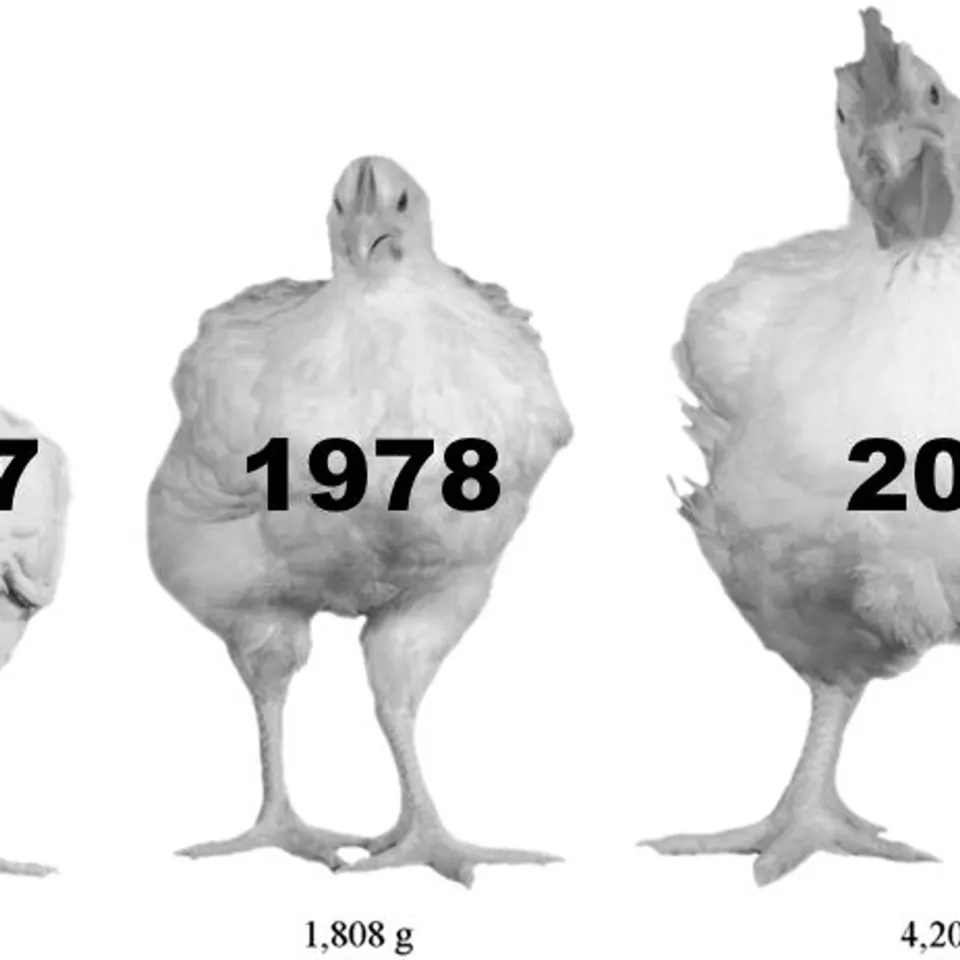
The young animal of this species is called a "chick." The female chickens exploited for their meat are called "broiler" chickens: the Hubbard breed, the Arbor Acres breed and other hybrids that have been genetically crossed to produce chickens that put on weight as fast as possible, to get the greatest possible economic profit. Researchers at the University of Alberta, in a study titled "Growth, efficiency, and yield of commercial broilers from 1957, 1978, and 2005," found that in 1957 chickens raised for meat weighed an average of 905 grams at 56 days of life, while in 2005 chickens raised for meat weighed an average of 4,202 grams, that is, chickens five times heavier on the same amount of food. These deformed chickens have mobility and cardiovascular problems, including heart attacks.
The hen breeds most exploited for their eggs are the Leghorn and hybrid breeds such as the Lohmann, Hy-Line or Shaver, which, although small birds, produce large eggs. Rhode Island hens are usually used for both meat and egg production.
An egg is a rounded body of variable size and hardness, produced by the females of various groups of animals. Egg-laying (oviparous) vertebrates lay eggs with little or no development inside the mother, as do many invertebrates. This is the way of reproducing for many fish, amphibians and reptiles, all birds, monotreme mammals, and most insects and arachnids. When the egg develops inside the mother, this is called ovoviviparity. A hen's egg forms from an ovum (the yolk) and is covered with nutritive material (the egg white) and a protective layer (the shell). When they reach sexual maturity, at around 5 months of life, hens ovulate approximately every 26 hours, laying an egg even if they have not been fertilized. The egg is the hen's menstruation; chicks are born only from fertilized eggs.
Hens and roosters used to produce fertilized eggs
The hen's reproductive system consists basically of two parts: the ovary and the oviduct. The ovary produces the egg yolk. The oviduct adds the egg white, the shell membranes and the shell to the yolk to complete the formation of the egg.
In the pens, one rooster is placed for every 5 to 7 hens when they are less than a year old, since this is the stage of their lives when they have the greatest capacity to reproduce. During her 40 weeks of production, a heavy breeder hen lays around 180 fertilized eggs. These individuals are forced to mate again and again until they are too damaged to remain productive, at which point they are sent to the slaughterhouse.
Forming an egg takes more than 24 hours, so even the best hens cannot lay an egg every day throughout their productive lives. When a hen lays a fertilized egg, the chick embryo has already been developing for about 25 hours and is made up of roughly 20,000 embryonic cells. It is a living organism and is already breathing.
After 21 days of natural incubation (brooding) or artificial incubation (incubator), the chicks hatch. When chicks hatch, hens protect them for about 8 to 10 weeks and then forget about them. In industrial chick production this does not happen, since hatcheries use incubators. When the chicks hatch in the incubator, they are denied their mother's warmth and company, and are given artificial heat instead.
Many believe that protecting offspring is an attribute unique to mammals, but birds such as hens show that nothing could be further from the truth. Mothers make sounds that the embryos answer from inside their eggs. Hens protect their young, and prefer to have private nests in sheltered areas away from predators. According to the Humane Society, "a mother's desire for a private nest is so great that she will go without water or food so as not to lose her nest." Birds, like the mothers of many species, sacrifice their own needs for those of their young.
Chick sexing: the killing of male chicks
One-day-old chicks are placed on a conveyor belt or sexing carousel where they are treated as mere merchandise: they suffer stress, are knocked about, and sometimes suffer fractures. Once on the conveyor belt, they are sexed. Chick sexing consists of separating the males from the females. The sexing of one-day-old chicks has been practiced since 1925.
The reason chicks are separated by sex is that, for the poultry industry, males are not as profitable as females: males do not lay eggs and they put on weight less and more slowly. Because they are not profitable, male chicks are killed by the millions in hatcheries, either by gassing them in gas chambers or by throwing them into containers where they die of suffocation if they have not already died from the rough handling. The bodies of the male chicks are used for food or as fertilizer. For every laying hen, whether she lives confined in a cage or lives in "freedom," one male chick was killed at the hatchery.
Another common method of getting rid of unwanted male chicks is grinding them up alive. This can lead to unimaginable horrors, as described by a scientist who observed that "even after twenty seconds, there were only partly damaged animals with whole skulls." That is, fully conscious chicks were partially and slowly ground up in brutal agony. Accounts from witnesses at hatcheries describe similar horrors of chicks being slowly dismembered by the blades of the machinery on their way to the trash compartments or manure spreaders. In the United States alone, 200 million chicks are ground up alive every year.
The killing of male chicks is becoming better known to the public, which is creating social rejection of the practice. To deal with this rejection, some poultry farms are, in a few isolated cases, using "dual-purpose" hen breeds, in which the female lays eggs and the males are quickly fattened, as was common in the countryside in 1950.
Colored male chicks
Some male chicks manage to survive, but usually only for a short time. Of the millions of male chicks, some are sold at 7 or 8 days of life in "lots of no fewer than 50 units." These chicks are dyed and sold at street stalls as if they were toys. Chicks are generally dyed with vegetable food coloring, which is not toxic. Other times, however, they use fabric dye, which is made of chemical salts with other fixing compounds. Tartrazine is also used to give them a bright yellow color. If these dyes are not available, they use hair dye, which is corrosive in large amounts and can cause burns. Because of the dyes and the mistreatment, many chicks die in the process or from poisoning in the days after they are bought.
Beak amputation of female chicks
After sexing, in which the females are separated from the males, female chicks 5 to 10 days old have to go through having their beaks amputated, a common practice in the poultry industry. To make the mutilation sound less terrible, the poultry industry launched a marketing campaign to promote the terms "debeaking," "beak trimming" or "beak conditioning." Below we explain why their beaks are amputated. To increase profit in egg production, female chicks and adult birds are made to go hungry, which causes them stress. This stress adds to the stress of being overcrowded and results in birds pecking one another, causing wounds and cannibalism. By amputating their beaks, the exploiter prevents the hens from hurting each other and also reduces feed waste.
Beak mutilation is carried out with a debeaking machine. The machine amputates the tip of the chicks' beaks (bone, cartilage and soft tissue) with a hot blade that cauterizes the cut. In the days before the amputation, vitamin K and glucose are usually added to the water in the drinkers to prevent hemorrhaging. Burns and infections sometimes occur, not to mention the obvious pain of a mutilation without anesthesia.
The book Guide to Managing a Poultry Farm explains debeaking this way [5]:
"This practice has two purposes: to prevent cannibalism (which frequently occurs because of stress) and to reduce feed waste. It must be done quickly, since a debeaking machine with a hot blade is used, which generally cuts both the upper and lower part of the beak. The hot blade cauterizes (stops the bleeding of) the cut, thus preventing profuse bleeding. Cannibalism starts with pecking and pulling out each other's feathers, until the skin is broken or cut and bleeds. If it is not controlled in time at this bleeding stage, the most aggressive birds end up killing the weaker ones. The red color of blood is what attracts them most, so the cannibalism problem is more serious in birds with light or white plumage." Boris Coto, Guide to Managing a Poultry Farm
The male chicks that will be used as roosters to produce chicks also have their beaks cut, but a little less than the females, so that they can use the beak to hold the hen by the back of the neck during mating.
The beak has very important functions for birds. Besides being a means of defense and of sensing the world, it is the bird's mouth, and therefore the way in for food. Many birds whose beaks have been amputated die of starvation because their beaks heal stuck together, because of the pain of the wound, or because they cannot hold their food.
After sexing and debeaking, hatcheries sell the female chicks to industrial farms, to organic farms, to family operations and to private individuals. On organic or "free-range" farms it is also common to see birds with amputated beaks, since they are crowded together at night and the stress also tends to make them attack one another.
Female chicks destined for meat also have their beaks amputated, since they too are crowded together during the 21 to 39 days in which they are fattened quickly before being sent to slaughter.
Growing and fattening sheds for female chicks. Once their beaks have been amputated, the female chicks, or pullets, are crowded into fattening sheds or growing sheds, depending on whether they are destined for meat production (broilers) or egg production (layers).
Female chicks destined for meat have been genetically selected to put on weight quickly, which adds to their voracious appetite. When they are about a month old (21 to 39 days), they are sent to the slaughterhouse.
When they are 4 weeks old, female chicks destined for egg production are put on a feed restriction program, which causes them stress. The reason they are made to go hungry is that overweight mature birds (with excess fat) produce fewer and smaller eggs than hens at an adequate weight, and also face a higher risk of death from oviduct prolapse.
"Laying" hens crowded in cages, on the floor, "free-range" and "organic"
Hens and chickens are sensitive, intelligent and very sociable animals, individuals who like to spend the day cleaning and preening their feathers, pecking, sunbathing or taking dust baths.
At about 16 or 18 weeks of age the females are ready to lay eggs and are moved to a facility that generally consists of several buildings, each the length of a football field, filled with rows of metal cages. These are called "battery cages," conventional or unenriched, which in some countries can be as small as 300 cm² per hen. To maximize the production of each building, as many hens as possible are crammed into each cage. These cages have sloped floors so that the egg rolls onto a conveyor belt on the way to the next step of production. The cages are often stacked on top of one another all the way to the ceiling, which lets the urine and feces from the upper cages fall onto the cages below.
The cramped conditions prevent the animal from performing normal behaviors such as nesting and grooming, both important for hens. From constantly rubbing against the wire of the cages, they suffer severe feather loss, and their bodies are covered in bruises and abrasions. Forced to stand for an entire lifetime, their feet become deformed, the wire cuts their toes, which also curl and turn into claws from gripping an unsuitable surface. Sometimes in cold conditions their feet freeze to the bars. Because of the terrible living conditions, many hens die inside the cages, sometimes decomposing there.
Today each hen lays an average of 260 eggs per year. Statistics from 1940 showed a production of 134 eggs per hen per year, which gives an idea of the genetic and environmental manipulations carried out to double production. They suffer from "fatty liver syndrome" when their liver cells, working overtime to produce the fat and protein for the egg yolks, accumulate excess fat. They also suffer from what the industry calls "cage layer fatigue," and many animals die when their bodies are too weak to lay an egg. Osteoporosis is another common ailment afflicting laying hens, since their bodies lose more calcium to form eggshells than they can absorb from their diets. Some hens use an amount of calcium for annual egg production that is greater than the weight of their entire skeleton. The lack of calcium contributes to broken bones, paralysis and death.
"'Culling' is understood as the practice of detecting, first by sight and then by an individual physical examination, all those birds that do not show uniformity within a flock and that appear to be sick and/or are not producing. Once a hen that appears not to be in production is located, the separation of her pelvic bones is checked. These bones are located on both sides of the cloaca, and there should be a separation of about three cm between them. That separation or space is necessary because the egg must pass through it. It is very important to carry out this culling because non-productive birds reduce the profits of the operation. For this reason culling must always be rigorous. It is best done when the birds reach 15 weeks of age and again five weeks after production begins. After that it should be done at least once a month." Boris Coto, "Guide to Managing a Poultry Farm"
After 18 to 24 months, the egg production rate begins to fall, and that is when all the hens are classified as "spent" and are sent to the slaughterhouse.
Forced molting
Some factory farms force hens to go through one last egg production cycle before sending them to slaughter. In a process known as "forced molting," the birds are deprived of water and feed for 14 to 18 days to stimulate their bodies to complete another short, prolific egg-laying cycle. Because of the stress this causes, the hens lose almost all of their feathers. Commonly, between 5 and 10% of birds die of hunger or dehydration during the molt, and those that survive can lose more than 25% of their body weight. The most recent forced molting technique uses feed with little or no nutrients instead of withdrawing it completely. The hen in the photo was rescued from an egg factory with her body wrecked by this procedure.
Transporting hens from farms to slaughterhouses
"Spent" hens are transported by truck to the slaughterhouse. Before being loaded onto the truck, they are taken out of the cages and put into the truck's cages. The bones of their legs and wings are so fragile and decalcified that they often break during the process. The bodies of these hens usually end up as ingredients in soups, pies or lower-quality meat products, for which the bodies can be mangled, hiding the bruises from consumers.
Transporting hens to the slaughterhouse is an extremely traumatic event. The environment, smells and sounds unfamiliar to the birds, together with the motion, cause them great stress during transport, which often lasts several hours without rest and even days. Throughout that time the hens are deprived of water and food. Many of them do not survive the trip.
Hen slaughter
All hens, whether they have spent their lives in a cage or in "freedom," end up in the slaughterhouse once they stop being productive enough to be profitable, because to the exploiter a hen is not someone whose interests should be ethically considered, but something that produces profit. This is how the Guide to Managing a Poultry Farm explains it: "The ideal time to decide to eliminate a given flock of birds is when the value of the eggs produced equals the cost of the feed."
When the hens arrive at the slaughterhouse, the cages are unloaded and placed on conveyor belts. The hens are taken out of the cages one by one, and workers hang them by their feet from the hooks of a conveyor rail, where the hens struggle to break free. The rail carries them to an electrified water bath, designed to stun them before killing them. On many high-production industrial farms, processing is done so fast that many hens are not sufficiently stunned when they pass through the electrified bath. In the next area, automated blades cut their necks so they bleed slowly to death. Again, because of the speed of the process, many of the birds do not bleed out before reaching the scalding area, where they are boiled to dilate the follicles and make it easier to remove the feathers afterward, so these hens are boiled alive. Once the feathers are gone, a series of evisceration machines remove the head, feet and internal organs.
While it is usual for hens to be killed in the same slaughterhouses where chickens raised for meat are killed, the poultry industry is not satisfied with the profits it makes. The industry is also making killing on the farm itself routine. Current "disposal" methods include killing hens with CO2 and turning them into compost, breaking their necks (cervical dislocation) or grinding them up alive (maceration). In some cases, hens are thrown onto compost piles while still alive and try to free themselves.